

Tim Cook wants Apple Glasses, Vision Pro 2 lighter and cheaper
Apple CEO Tim Cook is pushing ahead with the development of the “Apple Glass” AR glasses despite technical hurdles.
According to the business portal Bloomberg, the glasses are intended to display augmented reality content directly on lightweight, everyday lenses – a miniaturization challenge that could be partially solved by outsourcing computing power to iPhones.
Two new Vision Pro models in the works
At the same time, Apple is working on two new Vision Pro models: a cheaper and lighter version (currently around 680 grams) is intended to tap into the mass market, while a wired Pro headset with ultra-low latency is being developed for precise applications such as surgical procedures or flight simulations.
The latter forgoes full immersion in favor of stable Mac connectivity, but retains passthrough technology.
Cook sees these steps as intermediate stages towards his long-standing goal of establishing AR glasses as the dominant wearable – a field in which Meta has already gained a foothold with its Ray-Ban smart glasses (so far without AR displays).
The technical dilemma remains critical
Real AR glasses require high-performance components in an ultra-compact design without compromising comfort and battery life.
However, the planned Vision Pro upgrades could strengthen Apple’s position in the mixed reality market until the “Apple Glass” vision becomes reality – which, according to experts, will unfortunately take a few more years.
Apple Vision Pro 2: Cheaper model and Mac connectivity in development
As Bloomberg journalist Mark Gurman reports , Apple is still pursuing plans for a more affordable version of the Vision Pro 2. Apple is currently working on two new versions of its mixed reality glasses. One will be lighter and cheaper than the current model, while the second will allow for a direct connection to the Mac.
The Mac connectivity aspect is particularly interesting. This technology was originally intended for AR glasses, but has now been applied to the Vision Pro. The primary purpose is to develop an extremely low-latency system that can both stream the Mac display and support demanding enterprise applications.
However, Apple’s long-term goal remains to develop AR glasses that are as comfortable to wear as regular glasses. The upcoming iterations of the Vision Pro are important steps toward this goal, the company continues.
Tim Cook “isn’t interested in anything else”: Apple is betting everything on this innovation
Tech giant Apple is tinkering behind closed doors on the next big thing after the iPhone: CEO Tim Cook (64) wants to produce digital glasses for everyday use. This is now the company’s top priority, reports the usually well-informed Apple insider Mark Gurman in the business magazine “Bloomberg.”
“Tim isn’t interested in anything else,” the digital journalist quoted a person familiar with the matter as saying. “It’s the only thing he really devotes his time to in product development.” The goal: to be faster and better than Facebook’s Meta!
According to Cook’s vision, the glasses of the future should be wearable all day long. And they should be significantly different from the Apple Vision Pro (starting at €3,999), which was released last year. Instead of drawing the user into a closed virtual reality, they should complement digital content in the real world via a smart display. In the tech world, this is called augmented reality (AR).
According to Bloomberg, the development of AR glasses will take “many years,” particularly because the device offers limited space for the high-performance technology needed for everyday comfort. Displays and, above all, batteries capable of providing hours of power are not yet at the required level of development. At the same time, the price must remain attractive.
If all this works out, the new AR glasses could be the next “one more thing.” Apple CEO Steve Jobs (†56) always made this legendary announcement when things were getting exciting and customers could look forward to a real innovation.
Cook: “We will wonder how we lived without them”
Nine years ago, Apple CEO Cook said: “AR will take a while, because there are some really difficult technological challenges. But it will happen—and it will happen in a big way. And we’ll wonder how we ever lived without it. Just as we wonder today how we ever lived without our phones.”
Bloomberg reports that there will be several interim solutions before the envisioned AR breakthrough. For example, the Apple Watch and AirPods will be equipped with cameras – and a new version of the Vision Pro will be released. This version is expected to be cheaper and lighter. Many users of the current model complain about its heavy weight, which puts strain on the head, especially during extended use.
This is one of the reasons why the technologically impressive Vision Pro has so far failed to achieve mass market success. There are currently no regular applications beyond a few Apple short films specifically created for virtual reality.
Bloomberg: Apple Vision Pro 2 becomes lighter and cheaper, Apple develops second headset as Mac accessory
Apple’s €4,000 mixed reality headset is a commercial flop. After investing billions in the development of Vision Pro, the iPhone maker isn’t abandoning the product and is reportedly planning a much more powerful yet affordable successor.
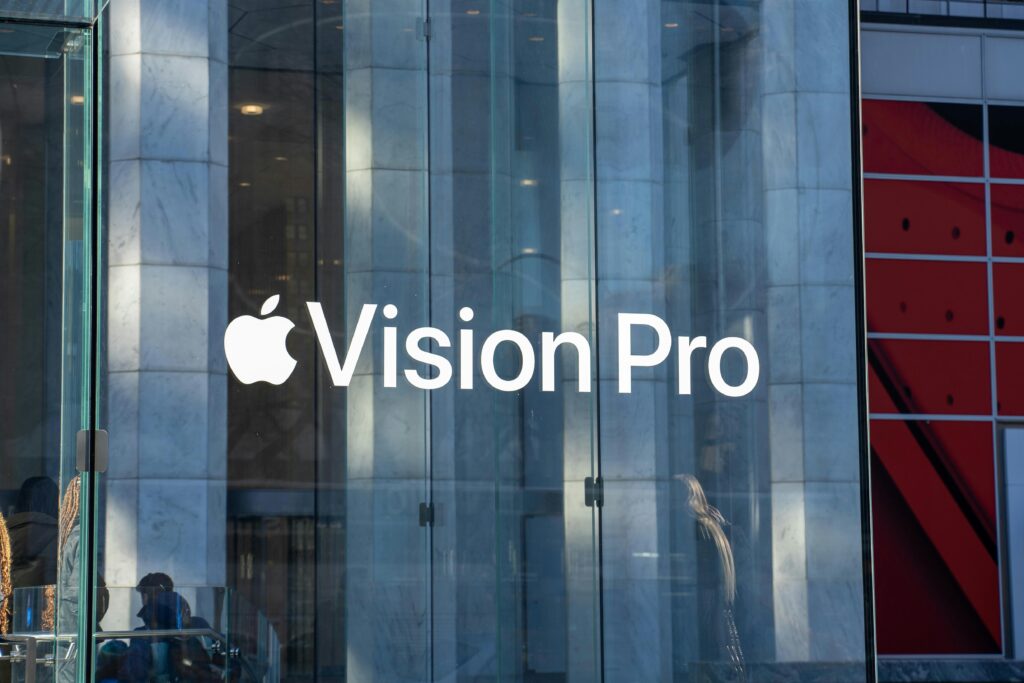
While rumors previously suggested that the successor to the Apple Vision Pro would primarily be an upgrade from the Apple M2 to the brand-new Apple M5, a Bloomberg report now points to more extensive changes. According to the report, Apple is said to be taking cues from the market leader, the Meta Quest 3 ( approx. €549 on Amazon ), in at least two areas, and designing the Vision Pro 2 to be both lighter and more affordable.
The Vision Pro weighs around 650 grams, even though the 353-gram battery isn’t integrated into the headset and instead has to be stored in a trouser pocket. By comparison, the Meta Quest 3 mixed reality headset weighs only 513 grams despite its integrated battery, which can lead to significantly greater comfort, especially during extended use.
In addition to the heavy weight, Apple is said to believe the price of €3,999 for the base model with 256 GB of storage is the main reason why the headset isn’t selling particularly well. It’s currently unclear how much Apple will be able to reduce the price.
The Cupertino-based technology
The Cupertino-based technology giant is said to be planning a second headset at the same time. A version of the Vision Pro that does not use a powerful ARM chip and instead requires a cable to connect to a Mac. This could make this headset significantly cheaper. And eliminate the need for its own battery, while the higher performance of a Mac could lead to lower latency.
This would make this headset interesting, among other things, as a mobile monitor for a Mac. But also for industrial applications such as flight simulators. Apple’s goal is still said to be to develop slim augmented reality glasses that users can wear all day. But such a product is said to be “many years” away.
Vision Pro 2 reportedly in production
Apple has reportedly already stopped production of the first Vision Pro. Now it looks like the second generation will follow.
Apple is apparently close to starting production of the second-generation Vision Pro. That’s at least the claim of a Chinese portal. According to sources close to Apple’s supply chain, key components such as the motherboard, display panels, and casing are already prepared for mass production, ITHome reports . However, the portal itself cites reports.
Will the Vision Pro remain a luxury item?
The Vision Pro first launched in the US in February 2024 , followed by internationalization in the summer. With sales launches in Germany and other countries. Since winter, there have been repeated rumors that production of the current model has been discontinued. Because Apple has sufficient quantities in stock. The fundamental problem: Although the headset received good to excellent technical reviews. With entry-level prices starting at €4,000, which Apple still hasn’t lowered, the barrier to purchase is high.
The Vision Pro 2 is expected to be cheaper – but by how much is unclear. Alternatively, it’s also conceivable that Apple might improve the hardware. Perhaps with a faster M4 SoC – but leave the pricing unchanged. If that were the case. However, the company would have to ask itself how sensible this strategy is for a luxury product. In addition to internal improvements, rumors suggest a slightly improved design could also be on the horizon. The Vision Pro is still quite heavy. And also requires you to carry around a battery pack connected to a cable.
Inspiration for other headsets
Interestingly, several companies have nevertheless been inspired by Apple’s less-than-popular design, including Samsung and the Chinese company Vivo . Google’s Android XR operating system also incorporates elements from the Vision Pro operating system, visionOS. The reason appears to be that Apple’s form factor allows for very powerful headsets. Although it is significantly less practical to use than devices with built-in batteries, such as the Meta Quest 3.
ITHome reports that the Vision Pro 2 is expected to ship this year. Analysts such as Ming-Chi Kuo and Bloomberg journalist Mark Gurman had predicted a release date. Between fall 2025 and spring 2026.
Sources used:
- With material from the News agencies Bloomberg.com, Reuters news agency. With information from Apple Official Website. Statement and reports from reputable news sources, including Wikipedia, BBC, CNN. The content has been independently analyzed and rewritten to provide original insights.

Welcome to TrendFiTech, your go-to source for the latest trending news, technology updates, and financial insights. Our mission is to provide accurate, informative, and engaging content to keep you updated on global trends, innovations, and market movements.
At TrendFiTech, we cover:
✅ Trending News – Stay informed with the latest happenings worldwide.
✅ Technology – Discover innovations, gadget reviews, and tech trends.
✅ Finance – Get expert insights on investments, business, and economic updates.
We are committed to delivering high-quality, original content while ensuring a user-friendly and informative experience.
Thanks!