
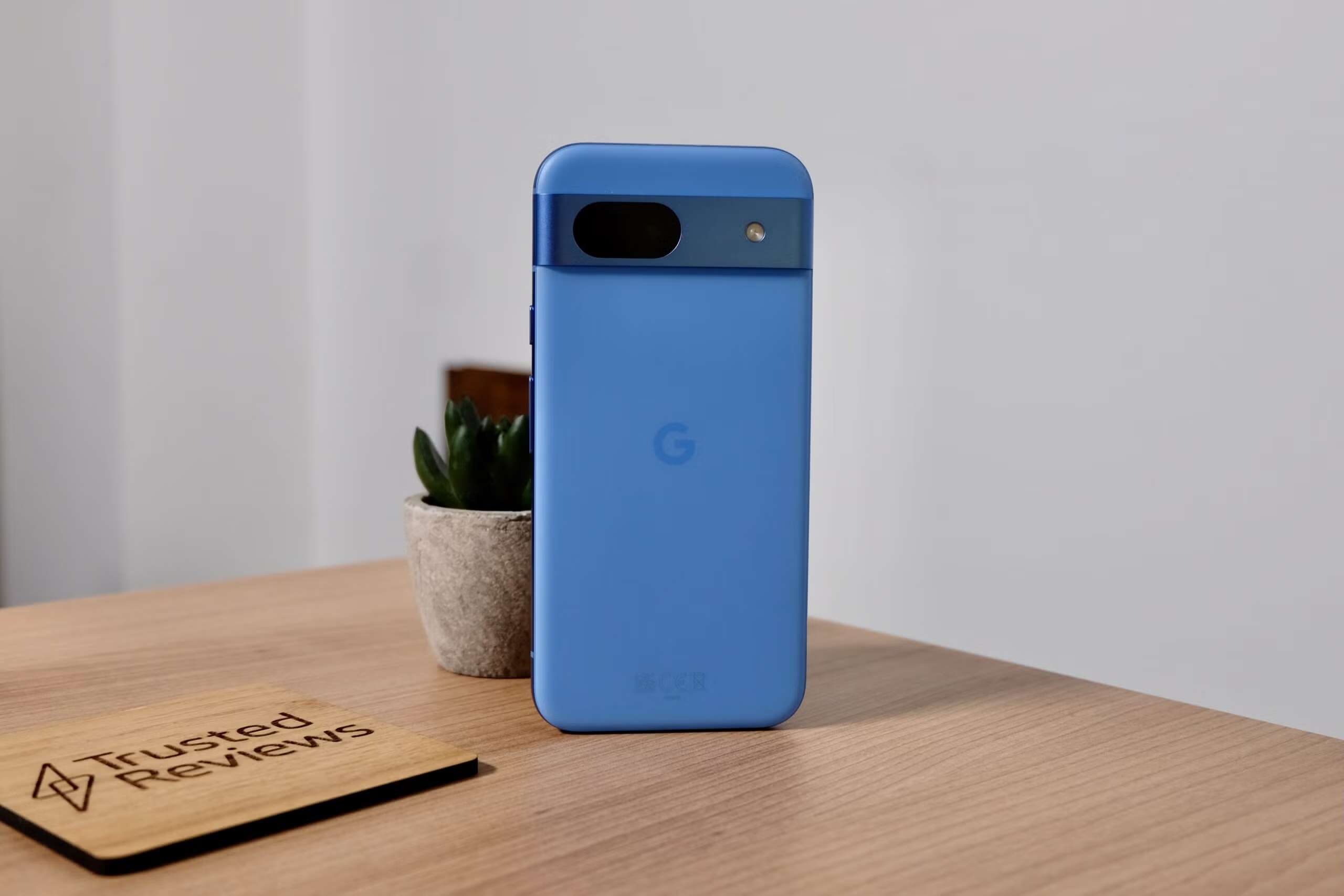
Google Pixel 9a goes on sale on April 14
After a short-term delay, the mid-range smartphone will be launched in two weeks, but before that, in the US. Google has confirmed the release dates for its Pixel 9a. The smartphone will be available in the UK, Canada, and the US starting April 10, 2025. Germany, Austria, Switzerland, and other European countries will be available on April 14. According to Google, Japan is currently only “coming soon.”
The company unveiled the device ten days ago, and, as is usual with Pixels, an early sales launch was expected. Instead, only April was mentioned as a date, but now Google has confirmed the specific dates . Pre-orders from retailers will not be available until the sales launch, at least according to Google.
The Pixel 9a is considered a beacon of hope for the current mid-range Android smartphones and is expected to cost starting at €549 with 128 GB of flash storage and 8 GB of RAM. It also features a 6.3-inch OLED display, the Google Tensor G4, a powerful SoC for its class, and two cameras, one of which is 48 megapixels. Google is also enticing customers with a seven-year update promise and a new design without the camera bar on the back that has traditionally been seen on Pixels. Further details can be found in a previous report .
Problem with passive component
The company had previously not commented on the reasons for the delayed market launch, but has now done so in response to 9to5Google . According to the company, there were quality issues with a “passive component,” which could be a resistor or capacitor, for example. According to Google, this could have affected the longevity of the smartphone and has now been resolved. Furthermore, only a small percentage of devices were affected.
Google Pixel 9a: Market launch in Germany after delay
Google has finally announced the launch date for the Pixel 9a, after delaying the budget smartphone’s launch. The device was originally scheduled to launch in March, but a component quality issue led to a delay. The Pixel 9a is now expected to be available in Germany on April 14.
The Pixel 9a is powered by the Google Tensor G4 processor, supported by the Titan M2 security chip, and 8 GB of RAM. Buyers can choose between 128 GB and 256 GB of internal storage, which, as is typical with Pixel devices, is not expandable. The 6.3-inch pOLED display offers a resolution of 2,424 pixels and reaches a peak brightness of up to 2,700 nits. It supports HDR and is protected by Gorilla Glass 3.
Another highlight is the 5,100 mAh battery, which can be charged via USB-C or wirelessly via Qi. The Pixel 9a’s body measures 154.7 x 73.3 x 8.9 mm, weighs approximately 185.9 grams, and is IP68 dust and water resistant. Particularly striking is the almost flat camera design, which barely stands out from the body.
The Pixel 9a’s camera offers features like super-res zoom, night photography, and astrophotography. Videos can be recorded in 4K resolution at up to 60 frames per second. Stereo speakers are integrated for audio playback. In Germany, the Pixel 9a is available for €549 for the 128 GB version and €649 for the 256 GB version.
Launch Delay By Google
The launch delay may have given Google the opportunity to further improve the quality of the device and ensure it meets users’ high expectations. In a highly competitive budget smartphone market, it’s crucial that Google delivers a product with the Pixel 9a that impresses with both performance and value.
With the launch of the Pixel 9a, Google continues its strategy of offering powerful smartphones at an affordable price. This could be particularly appealing to users who value value without sacrificing the latest technologies. However, competition in this segment is fierce, and it remains to be seen how the Pixel 9a will fare compared to other devices on the market.
Experts expect the Pixel 9a to be well-received due to its technical specifications and attractive price. The combination of a powerful processor, high-quality display, and advanced camera features could make the device a popular choice for budget-conscious buyers. The coming months will show whether the Pixel 9a can meet expectations and how it compares to other smartphones in its price range.
Google Pixel 9a: Launch date announced after delay
Google has now announced the official launch dates for the Pixel 9a . The budget smartphone will launch in Germany on April 14. An earlier launch was originally expected after the March 19 unveiling, but Google postponed it to investigate a component quality issue.
Inside is the Google Tensor G4 processor, supported by the Titan M2 security chip and 8 GB of RAM. Buyers can choose between 128 GB and 256 GB of internal storage, which, as is typical with Pixel devices, cannot be expanded via microSD.
The 6.3-inch pOLED display has a resolution of 2,424 pixels, reaches a peak brightness of up to 2,700 nits, supports HDR, and is protected by Gorilla Glass 3. Power is provided by a 5,100 mAh battery, which can be charged via USB-C or wirelessly via Qi. The case measures 154.7 x 73.3 x 8.9 mm, weighs around 185.9 grams, and is IP68-rated against dust and water. A striking design feature is the almost nonexistent camera bump.
Google touts camera features like super-res zoom, night photography, and astrophotography; videos are possible at up to 4K resolution at 60 frames per second. Stereo speakers are integrated for sound playback. Google is asking €549 in Germany for the 128 GB version, while the 256 GB version costs €649.
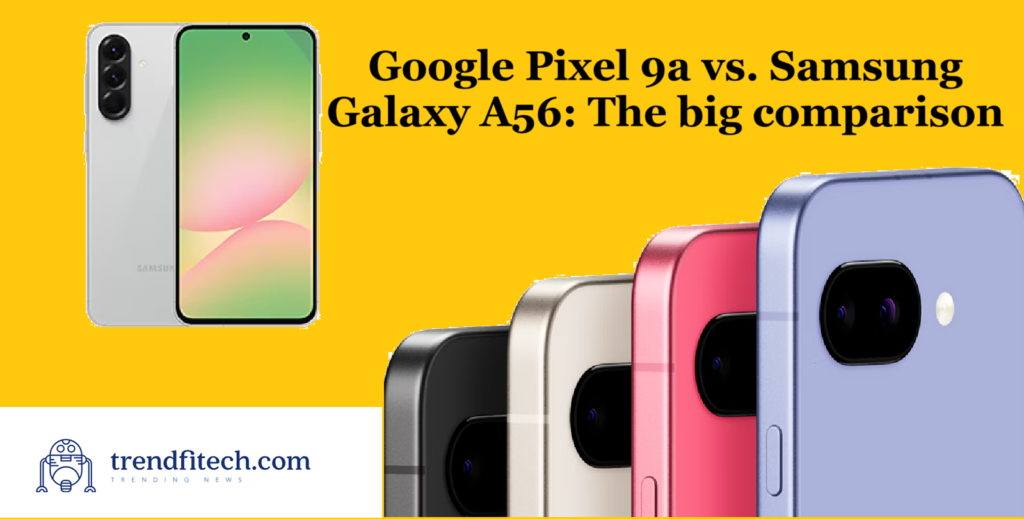
Google Pixel 9a vs. Samsung Galaxy A56: The big comparison
The Google Pixel 9a and Samsung Galaxy A56 are two hot contenders for the title of
best mid-range phone . Our comprehensive comparison reveals all the differences as well as the respective advantages and disadvantages of the two value-for-money hits.
Google Pixel 9a vs. Galaxy A56: Key differences
- The camera of the Google Pixel 9a is better
- The Pixel 9a is more powerful and better for AI
- Its water protection is better (IP68 vs. IP67)
- Only the Pixel 9a offers wireless charging
- The Pixel 9a gets 1 year longer updates
- The Galaxy A56 has a larger, more stable display
- The Samsung model has a higher quality casing
- The Galaxy A56 charges significantly faster (45 W vs. 23 W)
Design: Material and size differences
It’s immediately obvious: The Samsung Galaxy A56 is significantly larger , yet also noticeably thinner than the Pixel 9a. Interestingly, both manufacturers have decided to give their mid-range phones a different camera design than their premium devices in 2025.
The smartphones each feature a flat aluminum frame, but different materials are used on the back: While the Galaxy A56 has a glass back , the Pixel 9a has to make do with plastic . However, the Google Pixel 9a offers better water resistance (IP68 vs. IP67).
Display: Advantages on both sides
With a diagonal of 6.7 inches, the Samsung Galaxy A56’s display significantly exceeds the Pixel 9a’s 6.3-inch screen. The Samsung phone also benefits from narrower bezels and more robust screen protection (Gorilla Glass Victus+ vs. Gorilla Glass 3).
However, the Google phone scores points with its significantly sharper display (422 ppi vs. 385 ppi) and higher peak brightness (2700 nits vs. 1900 nits). Both displays are easy to read outdoors, though the Google phone is just a tad better. They also offer a refresh rate of 60 to 120 Hz for smooth display of animations.
Camera comparison: Google Pixel 9a vs. Galaxy A56
In the mid-range, hardly any mobile phone camera offers serious competition to the Google Pixel 9a – not even that of the Samsung Galaxy A56.
While the technical specifications don’t necessarily speak in favor of the Google smartphone, the manufacturer’s excellent image processing is in a class of its own and optimally utilizes the Pixel 9a’s camera hardware. The result is photos that can compete with, and sometimes even surpass, those of high-end phones .
Google Pixel 9a: Camera specifications
- 48 MP main lens: f/1.7, 1/2.0″ sensor
- 13 MP ultra-wide angle: f/2.2, 1/3.1″ sensor, 120-degree viewing angle
- 13 MP front camera: f/2.2, 1/3.1″ sensor
Galaxy A56: Camera specifications
- 50 MP main lens: f/1.8, 1/1.56″ sensor
- 12 MP ultra-wide angle: f/2.2, 1/3.0″ sensor, 123-degree viewing angle
- 5 MP macro lens: f/2.4, 1/5.0″ sensor
- 12 MP front camera: f/2.2, 1/3.0″ sensor
The Galaxy A56, on the other hand, simply offers a good camera for its price range. While it does have one more lens, the macro lens is negligible, especially since the Google Pixel 9a also allows macro shots via its main lens.
Both phones have AI-powered camera tricks up their sleeves. The most impressive of these is Google’s “Add Me” feature: The Pixel 9a lets you add people to group photos afterward.
Performance and AI
Thanks to its flagship processor, the Google Pixel 9a has performance advantages over the Galaxy A56, especially in AI applications, which is where the Google Tensor G4 specializes.
Google Gemini is available on both smartphones. However, both the Pixel 9a and Galaxy A56 offer AI features that aren’t available on the other. The Pixel 9a has access to the more interesting ones (including “Add Me” and “Pixel Studio”) and offers a better overall AI experience.
The so-called “Awesome Intelligence” on the Galaxy A56 is essentially just a slimmed-down version of the “Galaxy AI” (used on Samsung’s flagships). Due to the mid-range chip (Exynos 1580) installed, it couldn’t do much more.
Battery and charging
The battery comparison between the Galaxy A56 and the Google Pixel 9a is a close one. The smartphones’ battery capacities differ only slightly: The Pixel 9a’s 5100 mAh compares to the Samsung phone’s 5000 mAh . The manufacturers list the battery life as follows:
- Google Pixel 9a: over 24 hours of battery life with typical use
- Galaxy A56: up to 29 hours of video playback
Due to the different usage scenarios, the values are difficult to compare. However, one thing is clear: both smartphones offer plenty of endurance.
The charging speed, on the other hand, clearly speaks in favor of the Galaxy A56 , which can be charged with up to 45 W. By comparison, the Pixel 9a’s limit is 23 W. However, only the Google Pixel 9a offers wireless charging (7.5 W).
Price comparison
The price difference is clear: Although both phones are mid-range, the Google Pixel 9a is positioned slightly above the Galaxy A56 – which is also reflected in the price. Even with 256 GB, the Samsung phone is cheaper than the entry-level version of the Pixel 9a:
Prices for the Google Pixel 9a (RRP)
- 128 GB: 549 euros
- 256 GB: 649 euros
Prices for the Galaxy A56 (RRP)
- 128 GB: 479 euros
- 256 GB: 529 euros
Source:
- With material from the News agencies Reuters news agency, BBC News and CNN reports. And Google Pixel. The content has been independently analyzed and rewritten to provide original insights.

Welcome to TrendFiTech, your go-to source for the latest trending news, technology updates, and financial insights. Our mission is to provide accurate, informative, and engaging content to keep you updated on global trends, innovations, and market movements.
At TrendFiTech, we cover:
✅ Trending News – Stay informed with the latest happenings worldwide.
✅ Technology – Discover innovations, gadget reviews, and tech trends.
✅ Finance – Get expert insights on investments, business, and economic updates.
We are committed to delivering high-quality, original content while ensuring a user-friendly and informative experience.
Thanks!