
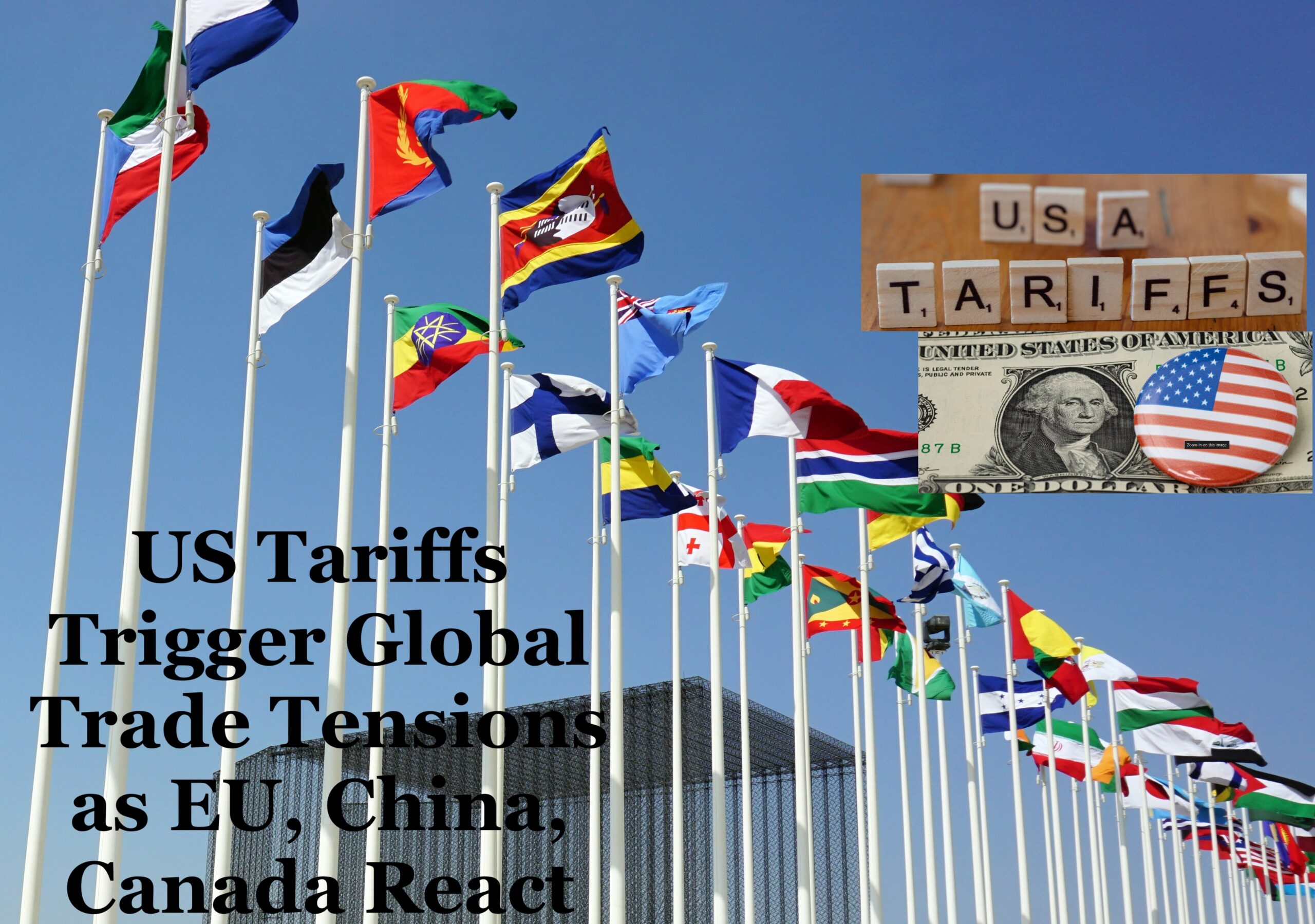
Canada and China also threaten: Announces countermeasures against US tariffs
Donald Trump has announced the US Tariffs hammer, but the reactions are not long in coming. The EU is preparing countermeasures, and Canada and China also intend to counter it. Ursula von der Leyen warns of drastic consequences, especially for the economically weakest citizens.
Following US President Donald Trump’s tariff announcement, the EU is preparing countermeasures but remains open to negotiations. “We are already finalizing the first package of measures in response to the steel tariffs and are now preparing further measures to protect our interests and companies should the negotiations fail,” said EU Commission President Ursula von der Leyen. The EU will also closely monitor the potential indirect effects of the tariffs. The EU cannot absorb global overcapacity, nor can it accept dumping in its markets.
At the same time, the top German politician emphasized that it was not too late for negotiations and appealed to the US side to engage in talks. The goal must be to reduce trade barriers, not to increase them.
Von der Leyen expects higher food prices
Regarding Trump’s decisions, von der Leyen said the universal tariffs against the entire world would be a severe blow to the global economy and would have immense consequences. “Millions of people will face higher food bills. Medicines will become more expensive, as will transportation. Inflation will rise. And this will especially harm the most economically vulnerable citizens,” she explained.
In addition, both large and small businesses will suffer from this decision from day one – including increased uncertainty, disrupted supply chains, and complex bureaucracy. In addition, there seems to be no order in this chaos, said von der Leyen. “There is no clear path through the complexity and chaos that is being created, as all of the United States’ trading partners are affected.”
Nevertheless, she called on EU citizens not to lose confidence. She said she knew that many people were disappointed in their oldest ally. But Europe had everything it needed to weather this storm. They would stand together and support one another. She announced swift discussions about possible support with the automotive and pharmaceutical sectors, which were particularly affected by the tariffs.
China and Canada want to counter
China also called on the US to immediately lift its latest tariffs and announced countermeasures. “China firmly opposes this and will take countermeasures to protect its own rights and interests,” the Chinese Ministry of Commerce said in a statement. The US move disregards the balance of interests achieved in multilateral trade negotiations over the years.
Canadian Prime Minister Mark Carney also announced countermeasures. These will be announced on Thursday, he said before a cabinet meeting. “It’s important to act with purpose and determination, and that’s exactly what we will do.” According to the U.S. Office of the President, the new base tariff of 10 percent does not apply to Canada. However, the U.S. tariffs of 25 percent remain in place on many goods related to drug and immigration issues.
US Treasury Secretary Scott Bessent warns affected countries against responding to the new tariffs with retaliatory measures. This will lead to an escalation, Bessent told Fox News.
These are the countries Trump wants to apply Tariffs
From Lesotho (50 percent) to Great Britain and Northern Ireland (10 percent), US President Trump has announced punitive tariffs for 38 countries. These are the affected countries and their planned tariff rates.
Donald Trump had been threatening for weeks, but in the end, his all-out attack was even more severe than feared. On Wednesday, the US president announced a mega-tariff package that, in his words, is directed against “the entire world.”
The package does not affect all of the US’s trading partners equally. Beyond the ten percent that will apply to imports from all countries to the United States, there are individual punitive tariffs – depending on whether the respective countries have particularly high trade barriers to American products from the US perspective.
An overview of the punitive tariffs for the most important industrialized and emerging countries as well as those US trading partners that are subject to tariffs of 30 percent or more:
| Countries List | Tariffs (%) |
|---|---|
| Lesotho | 50 % |
| Saint Pierre and Miquelon | 50 % |
| Cambodia | 49% |
| Laos | 48% |
| Madagascar | 47% |
| Vietnam | 46% |
| Myanmar | 44% |
| Syria | 41% |
| Mauritius | 40% |
| Bangladesh | 37% |
| Botswana | 37% |
| Fiji | 32% |
| Indonesia | 32% |
| Taiwan | 32% |
| Libya | 31% |
| Moldova | 31% |
| Switzerland | 31% |
| Algeria | 30% |
| Nauru | 30% |
| South Africa | 30% |
| India | 26% |
| South Korea | 25% |
| Japan | 24% |
| European Union | 20% |
| Argentina | 10% |
| Australia | 10% |
| Brazil | 10% |
| Saudi Arabia | 10% |
| Türkiye | 10% |
| Great Britain and Northern Ireland | 10% |
| Sri Lanka | 44% |
| Falkland Islands | 41% |
| Iraq | 39% |
| Guyana | 38% |
| Liechtenstein | 37% |
| Reunion | 37% |
| Serbia | 37% |
| Thailand | 36% |
| Bosnia and Herzegovina | 35% |
| China | 34% |
| North Macedonia | 33% |
| Angola | 32% |
Reactions to US tariffs: “Severe blow to the global economy”
Criticism of Trump’s tariff package was not long in coming: EU Commission President von der Leyen described the measure as a “severe blow to the global economy.” Others spoke of a “declaration of war” and a “wrongful ride.”
US President Donald Trump’s new tariff package is hitting many countries hard – including EU member states. EU Commission President von der Leyen was correspondingly critical. She spoke of a “severe blow to the global economy.” The tariffs would have horrific consequences for millions of people around the world, von der Leyen said during a visit to the Uzbek city of Samarkand.
The EU member states are already working on a “new package” of countermeasures “to protect our interests and our companies if the negotiations fail,” said the Commission President. At the same time, von der Leyen signaled her continued willingness to continue talks with the US government. “There is an alternative path,” said von der Leyen.
She pointed out that EU Trade Commissioner Maros Sefcovic is “in constant contact” with his US counterpart, Howard Lutnick. “We will strive to reduce the barriers, not increase them.”
Angry reactions and counter-tariffs
Bernd Lange of the Social Democratic Party (SPD), Chairman of the Trade Committee in the EU Parliament, spoke of “arbitrariness” that was “completely unacceptable” in the Tagesthemen (newspaper ). The announcements were a “declaration of war.” Lange expects damage to the EU in the high double-digit billion range. Trump’s tariffs are a declaration of war. However, Lange added that the EU is prepared and will respond with countermeasures.
Daniel Caspary, head of the German CDU/CSU MEPs in the European Parliament, called the tariff announcements from the White House a “complete catastrophe” and “a trade policy ghost ride by the US President.” Manfred Weber, President of the European People’s Party (EPP) in the European Parliament, believes Europe is ready to defend its interests in the trade dispute with the US. “For our American friends, today is not a day of liberation, but a day of bitterness,” the CSU politician wrote on Platform X. Donald Trump’s tariffs are damaging both sides of the Atlantic. “Europe stands united, ready to defend its interests, and open to fair, decisive talks.”
The Greens also called for similar measures for the services sector, for example, an EU digital tax or restrictions on American banks entering the European market. The EU Commission has already announced a package of counter-tariffs, which are scheduled to come into force on April 14. However, details have not yet been announced. EU Commission President Ursula von der Leyen plans to comment this morning.
Consequences also for Germany
Foreign Trade President Dirk Jandura also expects negative consequences for the German economy. “I’ll be quite frank: We will feel it,” the president of the Federal Association of Wholesale, Foreign Trade and Services (BGA) told the Reuters news agency. “We will have to translate the tariffs into price increases, and in many cases that means a decline in sales.” For smaller companies that have already emerged weakened from the last difficult years, this could also mean the end. This would then also affect their employees.
Hildegard Müller, President of the German Association of the Automotive Industry (VDA), described the US move as a fundamental shift in trade policy. “It represents the US’s departure from the rules-based global trade order—and thus a departure from the foundation for global value creation and corresponding growth and prosperity in many regions of the world. This is not America first; this is America alone,” the VDA President explained.
German Chemical Industry Association (VCI)
The German Chemical Industry Association (VCI) regretted the US government’s decision. “Now it’s important for everyone involved to keep a cool head,” said VCI Executive Director Wolfgang Große Entrup. “A spiral of escalation would only increase the damage. Our country must not become a pawn in an escalating trade war.” Brussels must remain flexible in its response and maintain close dialogue with Washington. Europe needs a strong mandate, also in the interests of German industry. “The goal must be a fair solution for both sides—for Europe and the US,” said Große Entrup.
Moritz Schularick, President of the Kiel Institute for the World Economy, described the new US tariffs as a severe shock to global trade. “If these tariffs remain in place in this form, it will be a turning point for the global economy as we know it. Then we’ll be in a different global trade regime. That’s really painful, including for the Americans,” Schularick told the Handelsblatt.
Emphasized calmness in other countries
Italian Prime Minister Giorgia Meloni calls the US tariffs “wrong.” She instead hopes for cooperation between the US and Europe to avoid a trade war, she says, which would weaken the West.
The French industry association FEVS expects a decline in wine and spirits exports of at least 20 percent. Association chairman Gabriel Picard told BFM TV.
According to Business Secretary Jonathan Reynolds, Britain will remain “calm and determined” to pursue an economic agreement with the US in the face of US tariffs. “We have a range of tools at our disposal and will not hesitate to act,” the statement read. Reynolds also pointed out that the US is the UK’s closest ally. The US has proposed tariffs of 10 percent for Britain.
According to Prime Minister Anthony Albanese, Australia will refrain from retaliatory tariffs. “We will continue to vigorously advocate for the removal of these unjustified tariffs for our exporters,” he said. The surcharges announced by the US are “not the act of a friend.” The measure will drive up costs for American households.
Impacts also on the stock markets
However, Canadian Prime Minister Mark Carney announced countermeasures. These would be announced on Thursday, he said before a cabinet meeting. “It’s important to act with purpose and determination, and that’s exactly what we will do.” According to the U.S. Office of the President, the new base tariff of 10 percent does not apply to Canada. However, the U.S. tariffs of 25 percent remain in place on many goods related to drug and immigration issues.
China also threatened retaliation. The People’s Republic has taken note of the announcement of reciprocal tariffs and firmly rejects them, the Ministry of Commerce in Beijing announced. China will protect its rights and interests.
Conclusion
Acting South Korean President Han Duck-soo ordered emergency measures to support companies affected by the US tariffs, the Ministry of Industry announced. “As the global trade war has become a reality, the government must use all its capabilities to overcome the trade crisis,” Han said at a meeting with the finance minister and other top officials, according to the ministry.
Shares of major technology companies initially fell significantly in after-hours trading in the US. Apple fell by 6.1 percent, Microsoft by 2 percent, and Nvidia by 4.7 percent. Amazon fell by 5 percent, Meta also fell by 4.7 percent, and Tesla by 5.9 percent. Alphabet fell by 3 percent, Alibaba by 3.9 percent, and Netflix by 2.8 percent. Companies in the chip industry also lost ground in after-hours trading.
Sources used:
- With material from the Reuters news agency. With information from Thomas Spickhofen, ARD Studio Brussels. Statement and reports from reputable news sources, including Reuters. The content has been independently analyzed and rewritten to provide original insights.

Welcome to TrendFiTech, your go-to source for the latest trending news, technology updates, and financial insights. Our mission is to provide accurate, informative, and engaging content to keep you updated on global trends, innovations, and market movements.
At TrendFiTech, we cover:
✅ Trending News – Stay informed with the latest happenings worldwide.
✅ Technology – Discover innovations, gadget reviews, and tech trends.
✅ Finance – Get expert insights on investments, business, and economic updates.
We are committed to delivering high-quality, original content while ensuring a user-friendly and informative experience.
Thanks!